
Summary
- Academic support for the outperformance of small caps goes back to the famous 1992 Fama and French study, “Common risk factors in the return of common stocks and bonds.” They analyzed returns from 1963 to 1990.
- Passive investing in the Russell 2000 Growth outperformed the S&P 500 from 1991 through 2014.
- The script shifted in 2015. The S&P 500 outperformed the Russell 2000 Growth over the 10-year period ending December 31, 2024, and for the last 4 years in a row. Those are long time periods for investors.
- The S&P 500 outperformed the Russell 2000 Growth because it has larger, higher quality companies and more exposure to the strong-performing Electronic Technology and less exposure to the underperforming Health Technology, in particular the Biotechnology subsector.
- The Needham Aggressive Growth Fund’s “Hidden and Quality Compounder” investment process has historically outperformed the indices.
I was recently asked by an astute financial advisor, “Why should I bother with small caps?” He observed that the S&P 500 has been such a strong performer and questioned whether small caps are worth the effort.
My answer: active management of small caps may offer real advantages. Small caps may offer diversification benefits and the potential for risk-adjusted outperformance. However, index investing in small caps has largely lost its edge. The key may be to invest in small caps through active managers who follow a disciplined process with a proven track record over time.
Of course, past performance is not a guarantee of future results. It is important for investors to do their own research and consult with their financial advisors before making any investment decisions.
Fama and French and the Outperformance of the Smaller Caps from 1963 to 1990
In 1992, Eugene Fama and Kenneth French published, “Common risk factors in the return of common stocks and bonds.” They analyzed returns from 1963 to 1990 and identified three factors that could explain 95% of the return in a diversified stock portfolio: market risk (excess return of the market minus risk free return), SMB (small minus big), and book-to-market equity.
The SMB factor contributed 4-5% per year of market returns. While small caps may exhibit higher volatility, investors that held them through market cycles were rewarded with higher returns over time.
Dr. French continues to maintain and update this data. Anyone can use it for analyzing market and factor performance. He is the Roth Family Distinguished Professor of Finance at Dartmouth College’s Tuck School of Business.
Continued Small Cap Outperformance – S&P 500 vs. Russell 2000 Growth from 1991 to 2014
Continuing on Fama and French’s study of small caps, from 1991 through 2014, the Russell 2000 Growth outperformed the S&P 500 in 13 of 23 years by an average of 1.5%.
We also analyzed Dr. French’s dataset from 1991 through 2024 by comparing the performance of the S&P 500 constituents – 30% of the largest versus the 30% of the smallest. The smaller companies outperformed the larger companies by an average of 5.8% per year.
Reversal from 2015 to Present – The Magnificent 7 and S&P 500 Outperform
The trend toward small caps has reversed in the last 10 years (actually 11 years if you look at a non-standard period). Since 2015, the Russell 2000 Growth has underperformed the S&P 500 by an average of 3.3% per year, lagging in 7 of the last 10 years. The trend has continued for the first 8 months of 2025. In fact, the Russell 2000 Growth Index has underperformed the S&P 500 for four consecutive years. This has been a long decade of underperformance.
It is hard to generalize why small caps have underperformed and when they may outperform again. People point to passive investment flows into the S&P 500, interest rates, domestic versus international business, and superiority of the Magnificent 7 business models, valuations, or other factors. One clear factor is that the top-performing Magnificent 7 stocks’ combined market cap make up 31.5% of S&P 500 as of June 30, 2025.
Rather than speculate on when small caps will rebound, I prefer to focus where we have seen consistent strength. I highlight our Hidden to Quality Compounders investment strategy, which has outperformed independent of the underlying weakness in small caps.
Why has the S&P 500 outperformed the Russell 2000 Growth?
We performed a 2-Factor Brinson analysis, using FactSet’s economic sector breakdown, comparing the S&P 500 to the Russell 2000 Growth from 2015 to 2024. The analysis shows the S&P 500’s outperformance results from about 30% allocation and 70% selection. Allocation and selection are interesting concepts to use when comparing indexes. Allocation is comparing the weighting of industry sectors. Selection is how the stocks in each sector performed compared to the stocks in the same sector in the other index.
As expected, the S&P 500 wins on most accounts. The S&P 500 is overweight the top performing Electronic Technology sector and underweight the lagging Health Technology sector. The other 70% of the outperformance came from superior returns from the stocks in almost every industry sector. The sectors with the most outperformance were Technology Services, Electronic Technology, Energy, Minerals and Finance. Large cap technology, energy and bank stocks performed better than their small cap peers.
For the last decade, it has simply made sense to buy the S&P 500 Index, rather than the Russell 2000 Growth Index.
Active Management of Small Caps May Outperform
However, we believe that active management of small caps may provide uncorrelated alpha relative to both the S&P 500 and the Russell 2000 Growth. Over time, our “Hidden to Quality Compounders” investment strategy has produced alpha. Past performance is not a guarantee of future results.
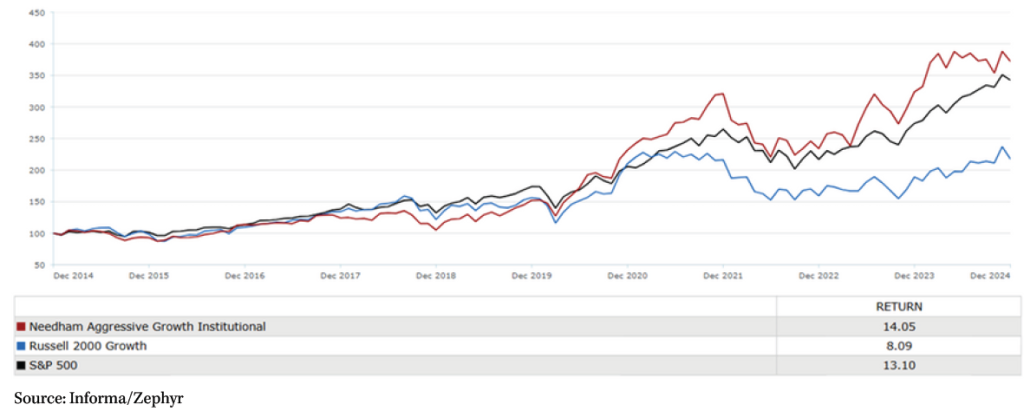
Needham Aggressive Growth Fund (NEAIX) beats the Russell 2000 Growth and the S&P 500
In the 10-year period ending December 31, 2024, the Needham Aggressive Growth Fund returned 14.05% annualized, compared to the Russell 2000 Growth’s 8.09%, and the S&P 500’s 13.10%.
Over the past ten years, the Fund outperformed in both allocation and selection relative to the Russell 2000 Growth. The top contributors to allocation were 1) an overweight allocation to the top-performing Electronic Technology, and 2) an underweight allocation to Health Technology. We have been investing in the “picks and shovels” of technology infrastructure for a long-time.
The Fund also had superior stock selection in Electronic Technology, Technology Services, and Producer Manufacturing. We believe the superior selection comes from our “Hidden to Quality Compounder” investment process.
The Fund outperformed the S&P 500 through allocations to Electronic Technology and Technology Services. While our Electronic Technology and Technology Services stocks outperformed the Russell 2000 Growth, they trailed the S&P 500 stocks in the sector.
Down Years
It is important to note that the Fund did not outperform the Russell 2000 Growth Index every year. In fact, over the ten-year period, the Fund underperformed in four. In each of those four years, weaker stock selection was the primary cause. Allocation contributed positively in 2015, 2018, and 2022, while 2017 was the only year when both allocation and selection detracted from relative performance.
In the three years where allocation was positive but selection was negative, underperformance was driven by idiosyncratic issues within several holdings that year. In the one year when allocation was also negative, it’s worth noting that Health Services and Health Technology were among the few sectors that significantly outperformed. Because the Fund has historically been underweight these areas, it lagged the Russell 2000 Growth during that period.
Being invested in the Fund during any of those four years would have been challenging. This is where patience and conviction matter. Our approach is built on the belief that, over time, disciplined investing and compounding in high-quality holdings will reward long-term.
The Impact of Compounding Over Time
If one had invested $10,000 in the Needham Aggressive Growth Fund on January 1, 2015, they would have $37,650 on December 31, 2024. The same $10,000 investment would be worth $21,898 in the Russell 2000 Growth and $33,963 in the S&P 500.
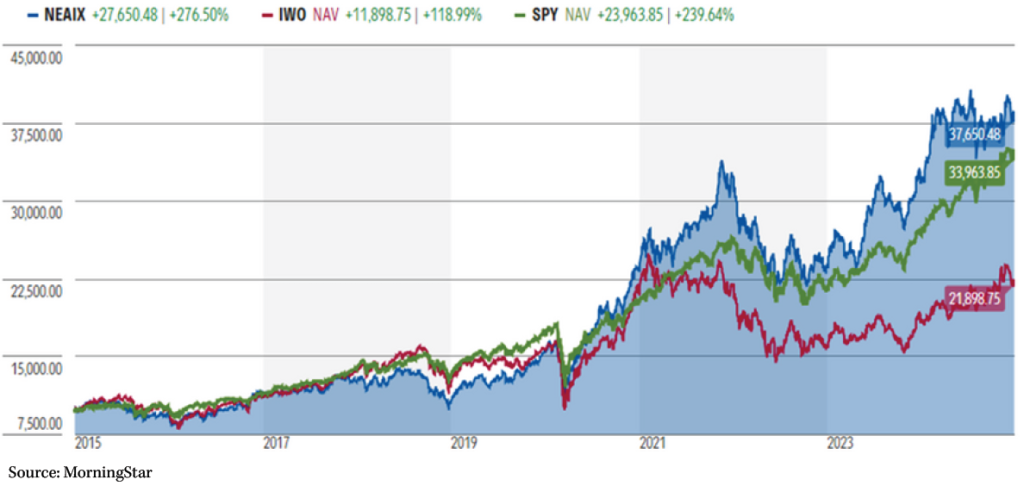
This illustrates an important truth: holding any of these equity investments over ten years or longer would have created wealth and required a great deal of patience and fortitude to hold through down periods. Charlie Munger often repeated Albert Einstein’s musing that “Compound interest is the eighth wonder of the world.” Needham Funds’ mission is to “Create Wealth for Long-Term Investors.”
Investors seeking exposure to small caps may want to evaluate the differences between passive and actively managed strategies, including risk, cost, and historical performance characteristics.
Conclusion
In conclusion, while passive small cap strategies have lagged large caps over the past decade, we believe there continues to be a compelling role for actively managed small cap funds within a diversified portfolio. Historical performance shows that active management, when supported by a consistent investment process and sector allocation, can lead to differentiated outcomes. That said, investors should recognize that small cap investing may involve higher volatility and may not always outperform. As with any investment decision, it is important to consider individual goals, risk tolerance and to consult with a financial professional.