
Market Review & Macro Observations
-
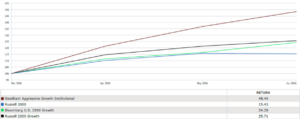
In 2Q26, the Bloomberg 2000 Growth, Russell 2000 Growth and Russell 3000 returned 24.28%, 25.71% and 15.44%, respectively. Information Technology significantly outperformed. Energy and Materials were the only sectors to post negative returns.[1]
-
With the closing of the Straits of Hormuz in April, oil peaked at $126/ barrel, before falling back to $70-75. In June, the U.S. and Iran signed a Memorandum of Understanding outlining terms to end the war. As shown by the strong equity returns and the return to normal oil prices, the markets seemed to be looking past the war to a world without oil and gas price volatility and perhaps a broader, long-lasting peace in the Middle East.
-
Inflation remains above the Federal Reserve’s 2.0% target. The Fed’s preferred inflation measure is the Core PCE (personal consumption expenditures), which excludes food and energy, which are seen as volatile. CPE inflation was 3.4% in May, 3.3% in April and 3.2% in March.[2]
-
The Bureau of Labor Statistics reported unemployment of 4.2% in June, consistent with the 4.2% – 4.4% of the last 6 months.[3]
-
1Q26 GDP was 2.1%, above the 1.6% from the preliminary estimates, as the impact of the war with Iran was not as severe as expected on U.S. GDP. The Atlanta Fed’s Blue Chip consensus shows 2.2% GDP growth for 2Q26.[4] Economic activity is benefitting from strong capital expenditures in AI infrastructure and technology-related business investment, offsetting weak residential housing.
-
At its April and June 2026 meetings, the Fed Open Market Committee maintained interest rates at 3.50 – 3.75%, but shifted to a tightening bias given the inflation above 2.0%. [5] As of late June, the Fed Forward Futures shows a 77% chance of one rate hike by year-end.[6]
-
In May, Kevin Warsh was sworn in as Federal Reserve Chair, replacing Jerome Powell. In November 2025, Mr. Warsh wrote a Wall Street Journal op-ed arguing that AI will be a “significant deflationary force,” [7] which could lead the Federal Reserve to be more cautious about rate hikes. He also said that he will communicate less about the Fed’s future plans than did his predecessors.
Portfolio Performance
-
Our mission is to create wealth for long-term investors. The Fund’s investment strategy is to find companies when they are Hidden Compounders and hold them until they become Quality Compounders.[8]
-
In 2Q26, the Fund’s Institutional (NEAIX) and Retail (NEAGX) classes returned 48.40% and 48.24% respectively. It was an extraordinary quarter of outperforming the Fund’s benchmark indices. The Fund outperformed due to its investments in traditional technology, semiconductors, and defense infrastructure.
-
The Fund’s top contributors for 2Q26:
-
Vicor Corporation (VICR) designs and manufactures modular power conversion devices. The company reported strong 1Q26 revenue, earnings and outlook including a book: bill ratio of 2.0. In May, Vicor announced a license agreement with a customer widely believed to be Advanced Micro Devices, Inc. (AMD). At its annual meeting in June, Vicor discussed short-term plans to expand capacity to meet strong demand. It also announced that its Gen-2 Vertical Power Delivery solution is expected to be available in 1Q27 for its lead customer Cerebras Systems, Inc. (CRBS).
-
Arteris, Inc. (AIP) is a leading supplier of semiconductor IP used to connect blocks on a system on chip. It reported strong bookings, revenue and earnings in the quarter and raised guidance. The company is on track for non-GAAP profitability by the end of 2026. In 2026, A leading hyperscaler expanded its use by adding a license to Arteris’ security technology and leading high-bandwidth memory maker adopted Arteris’ technology. CFO Nicholas Hawkins announced his retirement for personal reasons in the quarter.
-
The Fund invested in Vishay Intertechnology, Inc. (VSH) in 2024 when new CEO Joel Smejkal announced plans for Vishay 3.0. Vishay 3.0 was built around increased capacity to serve highgrowth markets, including for AI data centers and electric vehicle charging. 1Q26 results showed strong revenue, earnings and guidance, bolstered by a 1.34x book: bill ratio. Utilization at the new campus in Wales is expected to begin in 2H26. The new wafer fab in Itzehoe, Germany is on track for a 2027 ramp. In late June, Vishay raised $750 million to accelerate capacity expansion and pay down debt.
-
-
The Fund’s top detractors in 2Q26 were small relative to the contributors:
-
Vital Farms, Inc. (VITL) lowered its guidance in May for the third time this year. Revenue, margins and cap ex came down. Guidance for EBITDA shifted to close to break-even. Importantly, the company saw margin compression from pricing pressure. The market has concluded that Vital Farms ability to garner higher prices and margins has passed and we agree. Construction on the second egg processing facility in Seymour, IN has paused to preserve capital. It was a tough quarter for Vital Farms.
-
Huntington Ingalls Industries. Inc. (HII) is the sole USN aircraft carrier shipbuilder, 1 of 2 nuclear submarine builders and the largest builder of USN surface vessels. Huntington Ingalls reported a strong 1Q26, however shipbuilding margins were a bit lower than estimated. The U.S. has a plan to increase ship and submarine industrial capacity. We believe Huntington Ingalls is well- positioned.
-
Portfolio Changes
-
The Fund ended the quarter with an 4.6% cash position. It had strong inflows in the quarter. The largest new investment was Elmet Group Inc. Co. (ELMT), an IPO and a company we’ve known for several years. It is the sole U.S.-based processor of molybdenum and one of a few tungsten processors. Customers include leading U.S. defense, aerospace, and industrial companies. Other leading new investments were Lantronix Inc. (LTRX), a maker of embedded compute systems used in drones; Franklin Electric Co. Inc. (FELE), which makes industrial pumps and has seen growth in the data center market; and 3-D Systems Corporation (DDD), a 3-D printing equipment and services company with growth opportunities in the defense and medical markets.
-
Among the largest additions to established positions were Ambiq Micro Inc. (AMBQ), Evolv Technologies Holdings Ltd. (EVLV), and Vishay Intertechnology, Inc. (VSH).
-
Among the positions exited were Thermon Group Holdings (formerly THR) via the closing of its acquisition by CECO Environmental Corp. (CECO), Circle Internet Group Inc. Class A (CRCL) and Carter’s Inc. (CRI).
Techno Optimist – Marc Andreessen
-
History in the United States is on the side of the optimist. One can consider the news and the bear cases but in the end, we assume that over time the U.S. economy will be fine. As long-term investors, we have the luxury of looking beyond short-term macro issues.
-
Marc Andreessen is Co-founder and General Partner of a16z, officially named Andreessen Horowitz, which is a premier venture capital firm.
-
In 2024 he wrote It’s Time to Build [9], which is a collection of three of his blog post essays. He wrote, “Our nation and our civilization were built on production, on building. Our forefathers and foremothers built roads, and trains, farms and factories, then the computer, the microchip, the smartphone, and uncounted thousands of other things…”[10]
-
In the essay, The Techno-Optimist Manifesto, he wrote, “We believe everything good is downstream of growth.” [11] “We have a duty to be optimistic. Because the future is open, not predetermined and therefore cannot just be accepted: we are all responsible for what it holds.”[12]
-
Mr. Andreessen was recently interviewed on the Center for Strategic and International Studies (CSIS) podcast, [13] Betting on America. I recommend the interview.
-
When you think about the Needham Aggressive Growth Fund, think builders. Our major investment theme remains the importance of U.S. infrastructure—the lesser-known “pick and shovel” providers. Our portfolio companies sell into data centers, life sciences labs, semiconductor and other manufacturing plants, roads, airports, power plants, and more.
-
Four areas present throughout our investments:
- Semiconductor manufacturing
- Data Centers/ AI processing
- U.S. Manufacturing
- Defense Technology
- Public safety
- We believe the AI buildout and its use is still in an early stage. Economic returns on AI projects could be a big deal for productivity and the economy.
VICR: 6.94%; AMD: 0.00%; CRBS: 0.00%; AIP: 5.91%; VSH: 4.77%; VITL: 0.54%; HII: 0.49%; ELMT: 1.55%; LTRX: 0.54%; FELE: 0.39%; DDD: 0.35%; AMBQ: 0.94%; EVLV: 0.68%; THR: 0.00%; CECO: 0.00%; CRCL: 0.00%; CRI: 0.00%.