
Market Review & Macro Observations
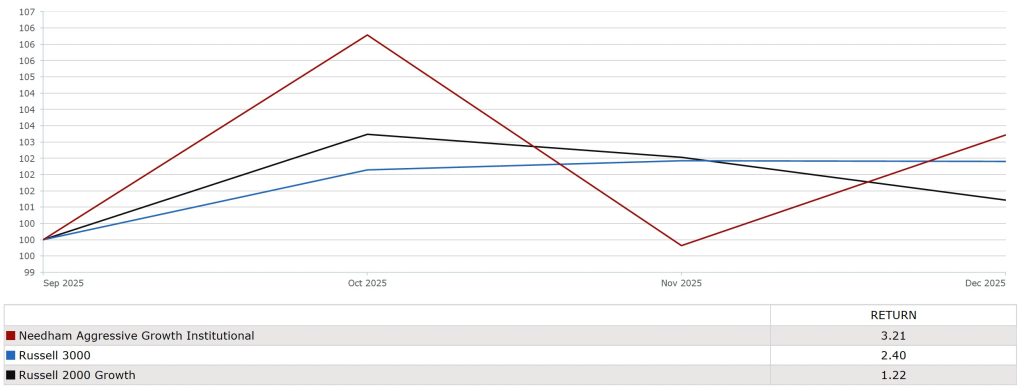
- In 4Q25, the Russell 2000 Growth and Russell 3000 returned 1.22% and 2.40%, respectively.
- Due to the federal government shutdown from October 1 – November 13, some economic data was not gathered, some statistics were not released, and other statistics were delayed.
- Personal Consumption Expenditure (PCE) core inflation was estimated to be 2.7% in October and 2.8% in November. [1] This inflation was similar to 2Q25 and 3Q25, although above the Federal Reserve’s 2% target.
- As of December, the Fed’s Summary of Economic Projections showed median projected 4Q unemployment of 4.5%[2], compared to 4.4% in September.[3]
- Economists believed trade restrictions and tariffs would slow growth in 4Q. In mid-November, expectations were for 1-2% growth. As of late December, the Atlanta Fed’s GDPNow model showed 3.0% annualized GDP growth for 4Q25.[4] The economy has proven to be resilient.
- As expected, at its December meeting, the Fed Open Market Committee cut the target rate from 3.75 – 4.00% to 3.50 – 3.75%.[5] The Fed expects one interest rate cut in 2026[6].
Impacts on Performance
- Our mission is to create wealth for long-term investors. The Fund’s investment strategy is to find companies when they are Hidden Compounders and hold them until they become Quality Compounders[7].
- In 4Q25, the Fund’s Institutional (NEAIX) and Retail (NEAGX) classes returned 3.21% and 3.10% respectively, outperforming the Russell 2000 Growth and the Russell 3000. In 2025, the Fund returned 27.09% and 26.51%, respectively, significantly outperforming the Russell 2000 Growth’s 13.01% and the Russell 3000’s 17.15%.
- The Fund’s top contributors for 4Q25:
- Vicor Corporation (VICR) designs and manufactures modular power conversion devices. Vicor announced strong 3Q25 revenue, earnings and outlook. Importantly, it also announced that its new Gen-5 vertical power delivery solution was exceeding technical expectations for its leading AI customer.
- Arteris, Inc. (AIP) is a leading provider of semiconductor intellectual property, specializing in interconnect technologies that manage on-chip communications. The company’s IP is used for System-on-Chip (SoC) designs for the AI, automotive, and advanced communications markets. Arteris reported a strong quarter.
- nLIGHT, Inc. (LASR) is a leading U.S.-based manufacturer of laser diodes and systems that sells into commercial and defense markets. For the third consecutive quarter, nLight was a top contributor. Our investment thesis in 2022 was that within five years, high-power lasers could be used to defend against drone attacks. It is happening even faster. nLight reported a very strong quarter led by its defense business. We expect significant developments in laser defense over the next several years and believe nLight could benefit.
- The Fund’s top detractors were:
- Super Micro Computer, Inc. (SMCI) supplies servers and systems for hyperscalers and enterprises and reported record bookings for the quarter ending September 30. As a result of a customer’s delayed installation plans for a very important, albeit low-margin hyperscaler, Super Micro missed quarterly revenue and earnings estimates.
- ThredUp, Inc. (TDUP) is a leading marketplace for the resale of lightly used clothing. ThredUp exceeded estimates for 3Q25 and raised guidance for 4Q25. However, the guidance for 4Q25 showed lower growth and margins than what was reported in 3Q25. We believe ThredUp is on a path to build a much larger business, which will bring margin expansion. Over the last year, ThredUp has been investing in AI for image search and inbound clothing processing, and it’s seeing results. ThredUp knows a lot about consumer purchasing trends and we believe it may be viewed as a data and technology logistics company, rather than a consumer retailer.
- With 16% trailing 12-month turnover, the Fund does not rotate into or out of sectors but invests in companies we believe may outperform over the long term.
Portfolio Changes
- The Fund ended the quarter with an 7.5% cash position, due to inflows. The largest new investments were in Atlanta Braves Holdings Inc. Class C (BATRK), LifeTime Group Holdings, Inc. (LTH), Modine Manufacturing Company (MOD) and Solstice Advanced Materials, Inc. (SOLS), which spun out from Honeywell (HON) in the quarter.
- Among the largest additions to established positions were CECO Environmental Corp. (CECO), Centuri Holdings Inc. (CTRI), Lincoln Educational Services Corp. (LINC), TETRA Technologies, Inc. (TTI), Universal Technical Institute, Inc. (UTI), Vishay Intertechnology, Inc. (VSH) and Vital Farms, Inc. (VITL).
- The Fund exited Klaviyo, Inc. Class A (KVYO) and Quest Resource Holding Corp. (QRHC).
Opportunities & Looking Forward
- History in the United States is on the side of the optimist. One can consider the news and the bear cases but in the end, we assume that over time, the U.S. economy will be fine. As long-term investors, we have the luxury of looking beyond short-term macro issues.
- The Trump Administration’s economic development strategy has a goal of revitalizing manufacturing in the United States. We were interested to hear that in a Davos talk, Secretary of the Treasury Scott Bessent called for 7-8% nominal GDP growth.
- Our major investment theme remains the importance of U.S. infrastructure—the lesser-known “pick and shovel” providers. Our portfolio companies sell into data centers, life sciences labs, semiconductor and other manufacturing plants, roads, airports, power plants, and more. Despite the current uncertainty, the U.S. has underinvested in these areas, so there may be long tailwinds. We continue to believe there may be compelling valuations in our small-cap “picks and shovels” universe.
- Four areas present throughout our investments:
- Semiconductor manufacturing
- Data Centers/AI processing
- U.S. Manufacturing
- Defense technology
- We believe the AI buildout is still in an early stage. Economic returns on AI projects could be a big deal for productivity and the economy.
- [1] https://www.bea.gov/data/personal-consumption-expenditures-price-index-excluding-food-and-energy
- [2] https://www.federalreserve.gov/monetarypolicy/files/fomcprojtabl20251210.pdf
- [3] https://www.wlwt.com/article/us-employment-rate-september/69488439
- [4] https://www.atlantafed.org/research-and-data/data/gdpnow/archive-of-past-gdpnow-commentaries
- [5]https://www.cnbc.com/amp/2025/12/10/fed-meeting-today-live-updates.html
- [6] https://www.fidelity.com/learning-center/trading-investing/the-fed-meeting
- [7] https://www.needhamfunds.com/growth-factor/maintaining-conviction-during-volatile-markets/