
Market Review & Macro Observations
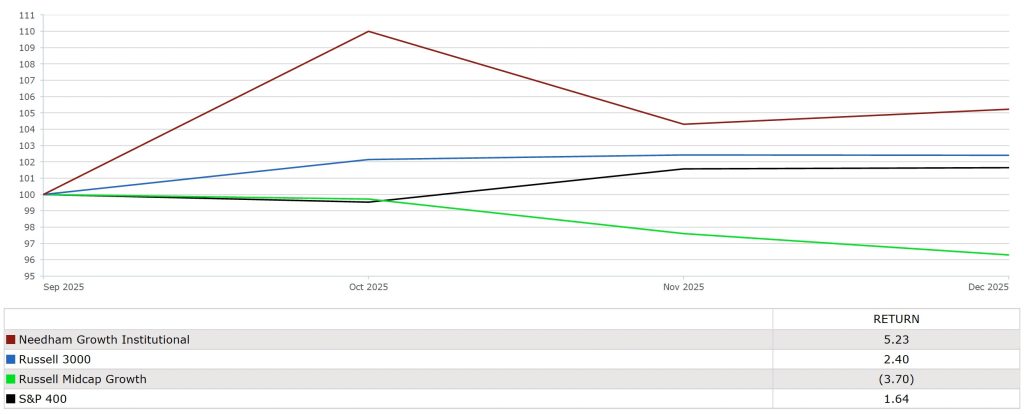
- In 4Q25, the Russell 2000 Growth and Russell 3000 returned 1.22% and 2.40%, respectively.
- Due to the federal government shutdown from October 1 – November 13, some economic data was not gathered, some statistics were not released, and other statistics were delayed.
- Personal Consumption Expenditure (PCE) core inflation was estimated 2.7% in October and 2.8% in November. This inflation was similar to 2Q25 and 3Q25, although above the Federal Reserve’s 2% target.
- As of December, the Fed’s Summary of Economic Projections showed median projected 4Q unemployment of 4.5%, compared to 4.4% in September.
- Economists believed trade restrictions and tariffs would slow growth in 4Q. In mid-November, expectations were for 1-2% growth. As of late December, the Atlanta Fed’s GDPNow model showed 3.0% annualized GDP growth for 4Q25. The economy has proven to be resilient.
- As expected, at its December meeting, the Fed Open Market Committee cut the target rate from 3.75 – 4.00% to 3.50 – 3.75%. The Fed expects one interest rate cut in 2026.
Impacts on Performance
- In 4Q25, the Fund’s Institutional (NEEIX) and Retail (NEEGX) share classes outperformed the benchmarks and the general market index returning 5.23% and 5.10%, respectively.
- Top Contributors:
- Vicor Corporation (VICR) designs and manufactures modular power conversion devices. Vicor announced strong 3Q25 revenue, earnings and outlook. Importantly, it also announced that its new Gen-5 vertical power delivery solution was exceeding technical expectations for its leading AI customer.
- FormFactor Inc. (FORM) supplies wafer probe cards to the semiconductor manufacturing industry. It reported a strong quarter, including gross margin expansion. FormFactor benefits from new logic and memory design starts. It maintained its market leading position by shipping to Micron Technology Inc. (MU), Samsung Electronics Co., Ltd. (005930.KS) and SK hynix, Inc. (000660.KS), which are the three leading HBM (high-bandwidth memory) manufacturers.
- Coherent Corp. (COHR) develops and markets lasers, optical transceivers and engineered materials for communications, industrial and electronics markets. It reported a strong quarter led by strength in the Datacenter & Communications segment.
- Top Detractors:
- Super Micro Computer, Inc. (SMCI) supplies servers and systems for hyperscalers and enterprises and reported record bookings for the quarter ending September 30. As a result of a customer’s delayed installation plans, including for a very important, albeit low-margin hyperscaler, Super Micro missed quarterly revenue and earnings estimates.
- Aspen Aerogels Inc. (ASPN) designs and manufactures aerogel-based insulation used in the energy industry for cryogenic and thermal applications, and in the automotive industry to prevent fires in EV batteries. Aspen reported a weak 3Q25. Most of Aspen’s 2025 and 2026 automotive business is from the General Motors EV lineup. The 2026 outlook for the EV market is uncertain. Other customers should start to contribute in 2027 and beyond.
- Parsons Corporation (PSN) provides engineering and technical services for the U.S. federal government and for critical infrastructure customers worldwide. Parsons guided revenue down, but maintained its adjusted EBITDA guidance. Parsons has suffered from delays and cancellations of U.S. government contracts.
Portfolio Changes
- The Fund ended the quarter with 1.7% cash. The largest of the new positions is Qnity Electronics, Inc. (Q), which was spun out of our holding in DuPont de Nemours Inc. (DD). Qnity supplies equipment and consumables for semiconductor manufacturing. Other new positions included Atlanta Braves Holdings Class C (BATRK), Generac Holdings Inc. (GNRC), SLB Limited (SLB) and Solstice Advanced Materials Inc. (SOLS), which spun-out of our holding in Honeywell International Inc. (HON).
- The Fund exited Figure Technology Solutions, Inc. (FIGR) , Klaviyo, Inc. Class A (KVYO) and a few very small positions recently purchased as IPOs.
Opportunities & Looking Forward
- History in the United States is on the side of the optimist. One can consider the news and the bear cases but in the end, we assume that over time, the U.S. economy will be fine. As long-term investors, we have the luxury of looking beyond short-term macro issues.
- The Trump Administration’s economic development strategy has a goal of revitalizing manufacturing in the United States. We were interested to hear that in a Davos talk, Secretary of the Treasury Scott Bessent called for 7-8% nominal GDP growth.
- Our major investment theme remains the importance of U.S. infrastructure—the lesser-known “pick and shovel” providers. Our portfolio companies sell into data centers, life sciences labs, semiconductor and other manufacturing plants, roads, airports, power plants, and more. Despite the current uncertainty, the U.S. has underinvested in these areas, so there may be long tailwinds. We continue to believe there may be compelling valuations in our small-cap “picks and shovels” universe.
- Four areas present throughout our investments:
- Semiconductor manufacturing
- Data Centers/AI processing
- U.S. Manufacturing
- Defense technology
- We believe the AI buildout is still in an early stage. Economic returns on AI projects could be a big deal for productivity and the economy.
[1] https://www.bea.gov/data/personal-consumption-expenditures-price-index-excluding-food-and-energy
[2] https://www.federalreserve.gov/monetarypolicy/files/fomcprojtabl20251210.pdf
[3] https://www.wlwt.com/article/us-employment-rate-september/69488439
[4] https://www.atlantafed.org/research-and-data/data/gdpnow/archive-of-past-gdpnow-commentaries
[5]https://www.cnbc.com/amp/2025/12/10/fed-meeting-today-live-updates.html
[6] https://www.fidelity.com/learning-center/trading-investing/the-fed-meeting