Needham Small Cap Growth Fund – 4Q25

Download PDF

Market Review & Macro Observations

  • Capital spending within the technology sector continues to drive significant economic activity. This spending broadens revenue opportunities within supply chains.
  • The Treasury yield curve has steepened and remains healthy for capital markets as equity and debt issuance have recovered from the post-COVID-19 lows.
  • Merger and acquisition activity returned throughout 2025 and is a positive signal for the economy, as deals can be viewed as investments in future growth.
  • After the passage of the “One Big Beautiful Bill Act,” markets finally gained clarity on tax policy for the foreseeable future. Company management teams, many of which delayed capital deployment decisions, can now prepare business plans with more certainty.
  • Tariff clarity remains a moving target as negotiations continue with many countries. However, it seems the worst of the adjustments and headline risk was witnessed earlier in 2025, when the markets suffered a significant correction.
  • The recent shift toward deregulation is expected to unlock additional economic activity as companies will be able to operate without previous regulations. Bank deregulation should also increase money flows and liquidity both on Main Street and Wall Street.

Portfolio Performance

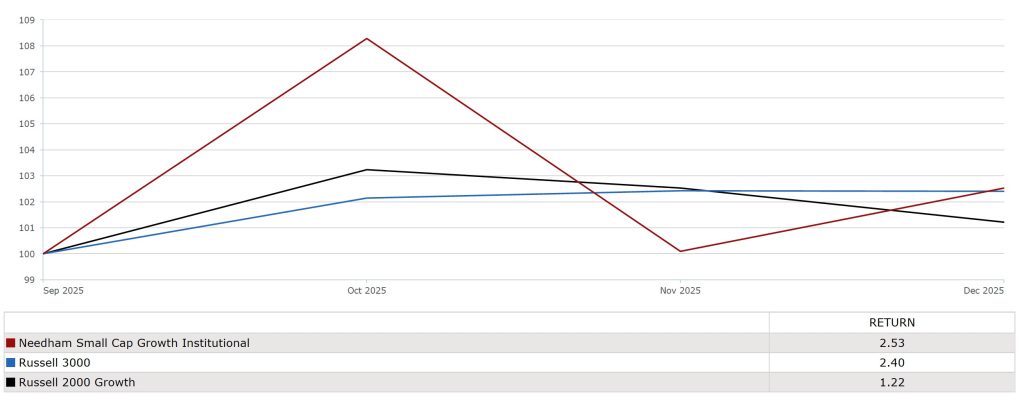
  • The Fund’s Institutional (NESIX) and Retail classes (NESGX) returned 2.53% and 2.41% respectively in the fourth quarter, compared to the Russell 2000 Growth’s 1.22% and the Russell 3000’s 2.40%.
  • We believe there is significant value within the small-cap asset class, and investor interest in small caps accelerated throughout 2025. Management teams continue to focus on improving cost structures and margins, accelerating revenue, and strengthening balance sheets.
  • The Fund ended the quarter with a 4.60% cash position following a significant market recovery throughout the quarter.
  • The Fund’s top five performers in 4Q25 were: Arteris, Inc (AIP), FormFactor, Inc. (FORM), Vicor Corp. (VICR), Photronics, Inc. (PLAB) and PDF Solutions, Inc. (PDFS).
  • The Fund’s top five detractors in 4Q25 were: Aspen Aerogels, Inc. (ASPN), Transcat, Inc. (TRNS), Penguin Solutions, Inc. (PENG), CEVA, Inc. (CEVA) and Super Micro Computer, Inc. (SMCI).

Outlook

  • With the U.S. administration’s redirection of economic and social policies, we expect economic activity to accelerate in 2026, as company management teams have gained greater certainty about what the policies mean for their businesses.
  • Tax certainty should benefit many of our portfolio companies, as accelerated tax benefits could propel capital spending and investment over many years.
  • Technology remains a long-term strength of the economy, and several major secular trends persist firmly in place to support continued growth. Areas of long-term investment that we continue to like are data centers, semiconductors and capital equipment, communications infrastructure, defense, data centers, and specialty material manufacturers. Innovation within our portfolio companies continues and long term, we believe these investments will benefit the Fund.
  • Despite recent narratives suggesting turbulence in the technology sector, our direct conversations with management teams tell a very different story. In more than 60 company visits over the last few months, one message stands out: demand remains exceptionally strong. Many companies are operating at or near sold-out capacity and are actively looking to expand capacity. This backdrop signals a healthy capital expenditure cycle. Companies continue to invest in growth, providing a solid foundation for sustained momentum. In short, what may look like “cooling” from a distance could be strength and disciplined expansion, when you speak directly to operators on the ground.
  • We expect a realignment of global trade, and that many U.S.-based companies will move investment and operations away from China. One theme we hear from management teams is the phrase “country for country” or “region for region” operations that will help to alleviate tariff risk. Many U.S. companies began this process years ago, however, the transition must make economic sense and can take a long time.

The Needham Small Cap Growth Fund’s Gross Expense Ratio is 1.86% for the Retail Class and 1.51% for the Institutional Class. The Needham Small Cap Growth Fund’s Net Expense Ratio is 1.79% for the Retail Class and 1.19% for the Institutional Class. The Net Expense Ratio reflects a contractual agreement by the Fund’s investment adviser to waive its fee and/or reimburse the Fund through April 29, 2026, to the extent the Gross Expense Ratio exceeds 1.85% and 1.18% of the average daily net assets of Retail Class Shares and Institutional Class Shares (Expense Cap), respectively. The Expense Cap excludes taxes, interest, brokerage, dividends on short positions, fees and expenses of “acquired funds,” extraordinary items, and shareholder redemption fees but includes the management fee.


The information presented in this commentary is not intended as personalized investment advice and does not constitute a recommendation to buy or sell a particular security or other investments. This message is not an offer of the Needham Growth Fund, the Needham Aggressive Growth Fund, or the Needham Small Cap Growth Fund (each a “Fund” and collectively, “the Funds”). Shares are sold only through the currently effective prospectus. Please read the prospectus carefully and consider the investment objectives, risks, and charges and expenses of the Fund carefully before you invest. The prospectus contains this and other information about the Fund.


All three of the Needham Funds have substantial exposure to small and micro-capitalized companies. Funds holding smaller-capitalized companies are subject to greater price fluctuation than those of larger companies. Needham Small Cap Growth Fund’s ownership as a percentage of net assets in the stated securities as of December 31, 2025: AIP: 6.62%, FORM: 2.02%, VICR: 0.00%, PLAB: 2.42%, PDFS: 4.31%, ASPN: 1.76%, TRNS: 2.42%, PENG: 1.32%, CEVA: 2.26% and SMCI: 0.72%.


The Russell 3000® Index measures the performance of the largest 3,000 U.S. companies representing approximately 96% of the investable U.S. equity market, as of the most recent reconstitution. The Russell 3000 Index is constructed to provide a comprehensive, unbiased and stable barometer of the broad market and is completely reconstituted annually to ensure new and growing equities are included. The Russell 2000 Growth Index includes those Russell 2000 Index companies with higher price-to-value ratios and higher forecasted growth values. An investor cannot invest directly in an index. Needham & Company, LLC is a wholly owned subsidiary of The Needham Group, Inc. Needham & Company, LLC, member FINRA/SIPC, is the distributor of The Needham Funds, Inc.


The source of the data for each of the Russell 2000 Growth Index and the Russell 3000 Index (together, the “Indexes”) is the London Stock Exchange Group plc and its group undertakings (collectively, the “LSE Group”). © LSE Group 2024. All rights in the Indexes vest in the relevant LSE Group company which owns the Index. The Indexes are calculated by or on behalf of FTSE International Limited or its affiliate, agent or partner. Neither the LSE Group nor its licensors accept any liability for any errors or omissions in the Indexes; no party may rely on the Index returns shown; and the LSE Group makes no claim, prediction, warranty or representation about the Fund or the suitability of the Indexes with respect to the Fund. No further distribution of data from the LSE Group is permitted without the relevant LSE Group company’s express written consent. The LSE Group is not connected to the Fund and does not promote, sponsor or endorse the Fund or the content of this prospectus.