
Market Review & Macro Observations
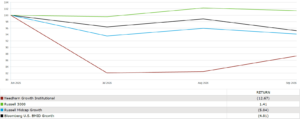
- In 3Q26, the Bloomberg Midcap Growth, Russell Midcap Growth and Russell 3000 returned -4.81%, -5.84%, and 1.41% respectively.
- Entering 3Q26, we had hoped that the U.S.-Iran Memorandum of Understanding could stabilize the oil market and lead to broader peace in the Middle East. However, the ceasefire collapsed in early July.
- Inflation remains above the Federal Reserve’s 2.0% target. The Fed’s preferred inflation measure is the Core PCE (Personal Consumption Expenditures), which excludes food and energy because they are seen as volatile. Year-over-year core PCE inflation held at 3.0% in July and August and accelerated to 3.1% in September.[1]
- The Bureau of Labor Statistics reported unemployment rates of 4.2% in June, 4.1% in July and 4.1% in August, consistent with the level of the last 18 months.[2]
- Real GDP grew at a 2.2% annual rate in 2Q26, revised up from 1.5% in both the advance and second estimates.[3] The Atlanta Fed’s GDPNow model pointed to even stronger growth for 3Q26: its estimate reached 5.1% in mid-September before ending the month at a solid 3.7%.[4] Growth near 5%, if sustained, would ease many macroeconomic pressures.
- At its September 2026 meeting, the Fed Open Market Committee raised interest rates to 3.75 – 4.00%, The updated Federal Reserve “dot plot” of future expectations shows one more 25bps increase by the end of 2026.
- 10-year interest rates rose to 5.3% from 4.4% at the beginning of the quarter. 5.3% was the highest since May 2002.[5] Small caps are often under pressure when rates rise. We believe that 5% is a very normal interest rate compared to the very low and zero-interest rate policies of recent years.
- In July and August, semiconductor and AI-related stocks fell. In July, The Wall Street Journal reported that NVIDIA was in talks to guarantee $250B of financing for OpenAI to lease a $500 billion data center project in southern Ohio, igniting concern over circular financing and debt funding of data centers and neoclouds.[6] These stocks rebounded 6 in September.
- The large, leveraged AI hedge fund, Situational Awareness LP, blew up in late July. It had almost no direct overlap with our portfolio’s holdings. However, its collapse pressured any stocks related to AI.
Portfolio Performance
-
Our mission is to create wealth for long-term investors. The Fund’s investment strategy is to invest in category leaders and emerging growth companies.
-
In 3Q26, the Fund’s Institutional (NEEIX) and Retail (NEEGX) classes returned -12.67% and -12.78% respectively. The same holdings that outperformed in 1H26 underperformed in 3Q26. Most of the companies suffered from multiple compression as their businesses produced strong results.
- The Fund’s top contributors for 3Q26:
-
- Super Micro Computer, Inc. (SMCI), which reported $60 billion in new orders during the quarter ending June 30, and $39 billion of revenue for the fiscal year ending June 30, 2026. Importantly, Super Micro also reported high double-digit gross margins, well above the last few quarters.
-
Thermo Fisher Scientific, Inc. (TMO), supplies life sciences tools, instruments, reagents, consumables, software, and services used by pharmaceutical companies, clinical labs, academic and government research centers. Thermo Fisher is the Fund’s longest holding at 26 years and is over a 50-bagger from the purchase price.
-
Hewlett Packard Enterprise Co. (HPE) provides hardware, software, and managed services. The company reported strong bookings for data center systems, networking equipment and cybersecurity. Juniper Networks, acquired by HPE in 2025, also performed well, including a major deal signed with Oracle Corporation in the quarter.
- The Fund’s top detractors in 3Q26:
-
- PDF Solutions, Inc. (PDFS), provides data analytics and Software-as-a-Service for the semiconductor industry and its suppliers and customers. We believe PDF is important for many of Intel Corporation’s (INTC) new initiatives. PDF Solutions had a strong quarter and guidance.
-
Vishay Intertechnology, Inc. (VSH) makes passive components and semiconductors used across industrial, automotive, computing, and other end markets. The Fund first invested in 2024, as CEO Joel Smejkal rolled out Vishay 3.0,[7] a growth strategy built around expanding capacity to serve high-growth markets. 2Q26 results showed strong revenue, earnings, and guidance, bolstered by a 1.32 book-to-bill ratio.
-
Corning, Inc. (GLW) reported a strong 2Q, led by its Optical Communications segment, though margins were pressured by costs of bringing new capacity online. During the quarter, Corning signed multiyear agreements with NVIDIA Corporation (NVDA) and Amazon.com, Inc. (AMZN) to supply optical connectivity for AI data center buildouts.
Portfolio Changes
-
With 23% trailing 12-month turnover, the Fund does not rotate into or out of sectors but invests in companies we believe may outperform over the long term.
-
The Fund ended the quarter with a 14.3% cash position. New investments were Boeing Co. (BA) and Dick’s Sporting Goods, Inc. (DKS).
-
Among the largest additions to established positions were AeroVironment, Inc. (AVAV), Centuri Holdings, Inc. (CTRI), MasTec, Inc. (MTZ), and Parsons Corp. (PSN).
-
Positions exited included Cerebras Systems Inc. (CRBS), Primoris Services Corporation (PRIM), and Waters Corporation (WAT), which we received on spin-out from Becton Dickinson & Co. (BDX).
-
Positions trimmed included many of the Fund’s long-term winners: Bruker Corp. (BRKR), CarMax, Inc. (KMX), Coherent Corp. (COHR), Solstice Advanced Materials, Inc. (SOLS), and Thermo Fisher Scientific Inc. (TMO).
Investment Opportunities
- Our major investment theme remains the importance of U.S. infrastructure – the lesser-known “pick and shovel” providers. Our portfolio companies sell into data centers, life sciences labs, semiconductor and other manufacturing plants, roads, airports, power plants, and more. Despite the current uncertainty, the U.S. has underinvested in these areas, so there may be long tailwinds. We continue to believe there may be compelling valuations in our small cap “picks and shovels” universe.
Five areas present throughout our investments:
1. Semiconductor manufacturing
2. Data Centers/AI processing
3. U.S. Manufacturing
4. Defense technology
5. Public safety